
Politics · Political families
Is Indian politics a family business?
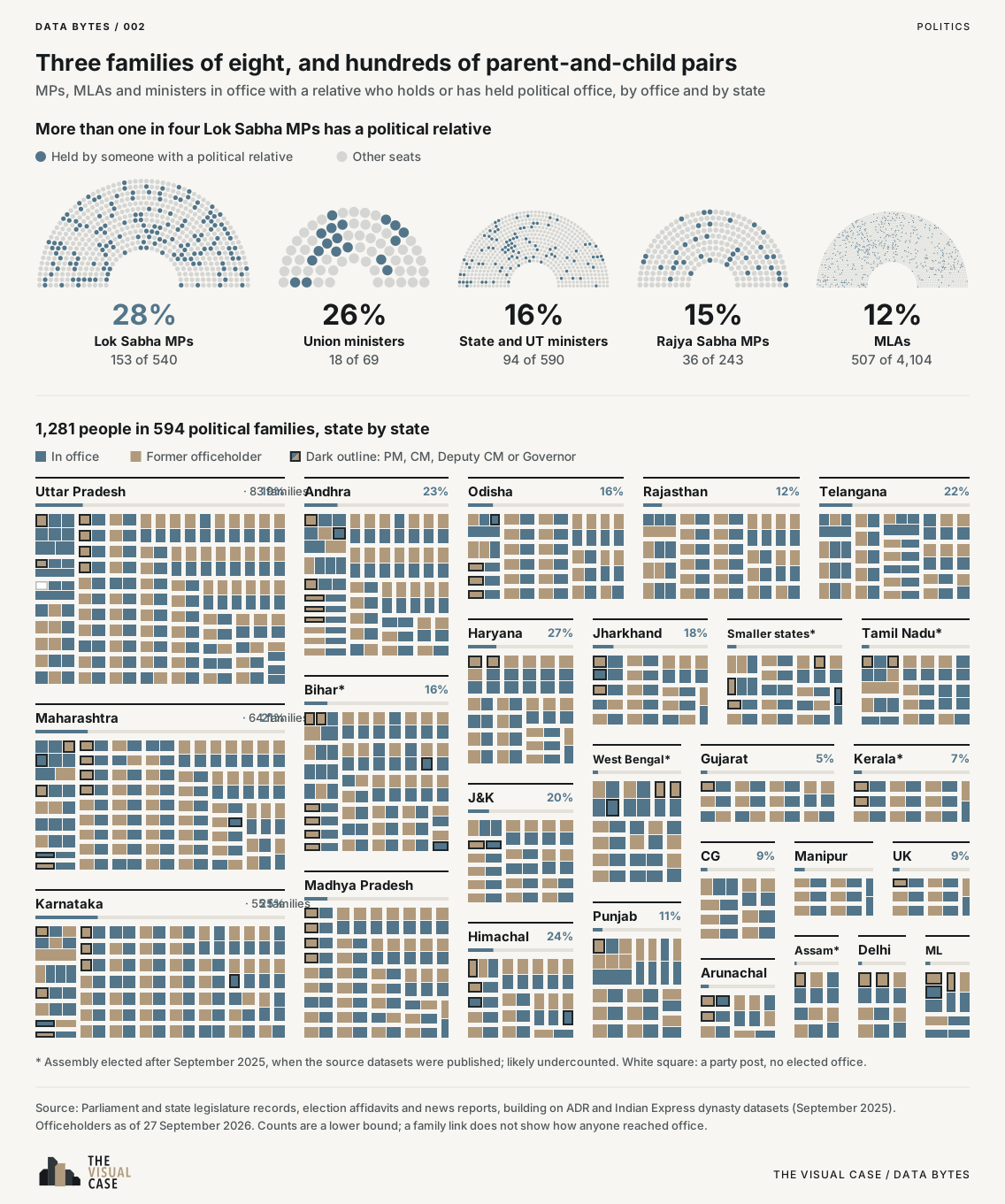
At least 702 of India’s 4,913 serving MPs, MLAs and ministers have a relative who holds or has held political office. In the Lok Sabha, it is more than one in four.
Three families of eight, and hundreds of parent-and-child pairs
MPs, MLAs and ministers in office with a relative who holds or has held political office, by office and by state
More than one in four Lok Sabha MPs has a political relative
Each dot is one seat. One person can hold more than one office.
- Held by someone with a political relative
- Other seats

1,281 people in 594 political families, state by state
Each square is one person: an officeholder in office on 27 September 2026 or one of their relatives. A state’s size reflects the number of people shown. These counts are a lower bound.
- In office
- Former officeholder
- Dark outline: PM, CM, Deputy CM or Governor

* Assembly elected after September 2025, when the source datasets were published; likely undercounted. The single white square is a relative who held a party post but no elected office.

| Office | Officeholders | With a political relative | Share (%) |
|---|---|---|---|
| Lok Sabha MPs | 540 | 153 | 28.3 |
| Union ministers | 69 | 18 | 26.1 |
| State and UT ministers | 590 | 94 | 15.9 |
| Rajya Sabha MPs | 243 | 36 | 14.8 |
| MLAs | 4,104 | 507 | 12.4 |
| State | Officeholders | With a political relative | Share (%) | Families | People shown |
|---|---|---|---|---|---|
| Uttar Pradesh | 524 | 98 | 18.7 | 83 | 181 |
| Maharashtra | 356 | 76 | 21.3 | 64 | 138 |
| Karnataka | 263 | 67 | 25.5 | 55 | 119 |
| Andhra Pradesh | 211 | 48 | 22.7 | 39 | 87 |
| Bihar* | 305 | 48 | 15.7 | 40 | 86 |
| Madhya Pradesh | 270 | 42 | 15.6 | 40 | 80 |
| Odisha | 178 | 29 | 16.3 | 27 | 57 |
| Rajasthan | 235 | 29 | 12.3 | 26 | 57 |
| Telangana | 144 | 32 | 22.2 | 24 | 55 |
| Haryana | 105 | 28 | 26.7 | 21 | 48 |
| Jammu and Kashmir | 99 | 20 | 20.2 | 18 | 37 |
| Himachal Pradesh | 75 | 18 | 24.0 | 17 | 35 |
| Jharkhand | 101 | 18 | 17.8 | 16 | 34 |
| Smaller states and UTs*† | 236 | 19 | 8.1 | 16 | 34 |
| Tamil Nadu* | 286 | 20 | 7.0 | 13 | 32 |
| West Bengal* | 348 | 20 | 5.7 | 14 | 32 |
| Punjab | 137 | 15 | 10.9 | 13 | 31 |
| Gujarat | 219 | 12 | 5.5 | 12 | 24 |
| Kerala* | 169 | 11 | 6.5 | 10 | 20 |
| Chhattisgarh | 106 | 10 | 9.4 | 8 | 17 |
| Arunachal Pradesh | 63 | 7 | 11.1 | 7 | 14 |
| Manipur | 61 | 8 | 13.1 | 7 | 14 |
| Uttarakhand | 78 | 7 | 9.0 | 7 | 14 |
| Assam* | 146 | 7 | 4.8 | 6 | 12 |
| Delhi | 80 | 6 | 7.5 | 6 | 12 |
| Meghalaya | 62 | 7 | 11.3 | 5 | 11 |
| No documented family link† | 56 | 0 | 0.0 | 0 | 0 |
| All officeholders | 4,913 | 702 | 14.3 | 594 | 1,281 |
Each officeholder is counted in their own state; each family is shown under the state where most of its serving members sit. * Assembly elected after the source datasets (Assam, Bihar, Kerala, Puducherry, Tamil Nadu and West Bengal); likely undercounted. † Smaller states and UTs: Tripura, Goa, Nagaland, Puducherry, Chandigarh, Dadra and Nagar Haveli and Daman and Diu, Lakshadweep and Sikkim, each with fewer than ten people shown. No documented family link: Mizoram, Ladakh, the Andaman and Nicobar Islands and the 12 nominated Rajya Sabha members.
We count seats. We count parties. Start counting families.
An election result tells us who won. A family tree tells us who else has been here before and who is still here alongside them. Put those two records together and another picture of Indian politics appears: 594 families, each connecting someone currently in office to a relative who holds or has held political office. That is a lot of family history inside public institutions.
The striking feature is how small most of these families are. In this count, 541 have just two documented political members. In 467, the connection is between a parent and a child. Only three families have eight members each. The scale comes from repetition: a pair here, another there, hundreds across the country. The records identify political families with serving members in every state except Mizoram.
Together, these connections reach at least 702 of the 4,913 MPs, MLAs and ministers in office on 27 September 2026. About one in seven. In the Lok Sabha, the share is more than one in four: 153 of 540 MPs. Among Union ministers, it is 18 of 69. Among MLAs, roughly one in eight.
The evidence needs to be read precisely. Fuller parliamentary biographies make MPs’ ties easier to document, and this remains an incomplete count. A relationship alone cannot establish favouritism or explain a political career.
But the pattern is substantial enough to demand attention in its own right. Every individual connection belongs to a biography. Taken together, they belong in our account of how political power is distributed. We already know how to ask which party holds a seat. We should get just as comfortable asking how many members of a family have held public office. The family belongs in India’s political arithmetic.
About the data
Who is counted. Members of the Lok Sabha and Rajya Sabha, MLAs, and Union, state and UT ministers serving on 27 September 2026: 4,913 people, each counted once. A relative counts if they held office as Prime Minister, Governor, Chief Minister or deputy, minister, Speaker, Leader of the Opposition, MP, MLA or MLC. Party posts and local-body offices do not count.
Evidence. Each link rests on an official record and a second source, or on two independent news reports. The official record is a candidate’s election affidavit or a parliamentary biography. The second source is a news report or a dynasty dataset from ADR or The Indian Express. Some well-documented links, such as Sharad Pawar and his nephew Ajit Pawar, were confirmed by hand. An affidavit names a parent, not the parent’s career, so a shared name alone does not count: links resting only on a name shared with a former officeholder were removed.
A lower bound. Only relationships named in two dynasty datasets, published by ADR on 12 September 2025 and The Indian Express on 20 September 2025, and in targeted searches were checked. Most officeholders have not had an exhaustive search, and several major news publishers that do not permit automated access were not consulted. States marked * elected their assemblies after those datasets.
Offices. Relatives’ past offices are as reported by the datasets and news reports; only Lok Sabha membership was checked against the official roll of members since 1952. The roster is a working list: 657 records, mostly MLAs in Maharashtra and Karnataka, rely on PRS Legislative Research lists pending official confirmation.
Reading the mosaic. Families are shown under the state where most of their serving members sit, so the Gandhi family appears under Uttar Pradesh; state shares count each officeholder in their own state. One serving MLA, Pallavi Patel, appears without being counted: her documented link is to her father, Sonelal Patel, who held a party post but no elected office (the white square).
What it does not show. A family link is not evidence of favouritism, and it does not mean that a family controls government. A review before publication removed two such namesake links, corrected three relationships and added two members of G. Venkatswamy’s family. Other errors may remain.
Primary sources
- Lok Sabha: member list, official biographies and the roll of members since 1952.
- Rajya Sabha: member list and official biographies.
- Union Council of Ministers: portfolios as on 25 July 2026, with later resignations from President’s Secretariat communiqués.
- State legislatures and governments: member and minister lists on NeVA and state websites, and PRS Legislative Research MLA lists where no official list was available.
- Election Commission of India: candidates’ election affidavits, read through ADR’s MyNeta transcriptions.
- Where the search started: ADR, analysis of sitting MPs and MLAs with a dynastic background (12 September 2025) and The Indian Express, India’s Political Dynasties (dataset as of 20 September 2025).
- Corroborating news reports from outlets including ThePrint, The Tribune, Free Press Journal, India TV, The Quint and Siasat, and PTI and IANS wire copy.